Monday, November 22, 2010

Mysterious Animals!

The marozi or spotted lion is variously claimed by zoologists and cryptozoologists to be a distinct race of lion adapted for a montane rather than savanna-dwelling existence, a rare natural hybrid of a leopard and lion, or an adult lion that retained its childhood spots. It is believed to have been smaller than a lion but slightly larger in size than a leopard and lacking any distinguishable mane. It has been reported in the wild and the skin of a specimen exists, but it has yet to be confirmed as either a separate species or subspecies, although Reginald Pocock and Belgian cryptozoologist Dr Bernard Heuvelmans both proposed the subspecific name Panthera leo maculatus for it (but this currently lacks any valid nomenclatural status).
undefined
undefined

Manananggal

Posted in 
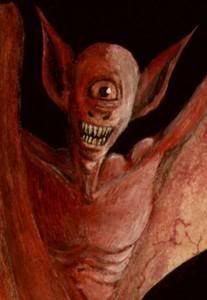
The Manananggal (sometimes confused with theWak Wak in some areas by the Filipinos) were called Penanggalan in Malay folklore is a mythical creature of the Philippines. It resembles a Westernvampire, in being an evil, human-devouringmonster or witch. The myth of the manananggal is popular in the Visayan region of the Philippines, especially in the western provinces of CapizIloilo,Antique. There are varying accounts of the features of a manananggal. Like vampires, Visayan folklore creatures, and aswangs, manananggals are also said to abhor garlic and salt.They were also known to avoid daggers, light, vinegar, spices and the tail of a sting ray which can be fashioned as a whip. Folklore of similar creatures can be found in the neighbouring nations of Indonesia and Malaysia.
undefined
undefined

Maltese tiger

Posted in 
The Maltese tiger, or blue tiger, is a suspectedcoloration morph of a tiger, reported mostly from the Fujian Province of China. It is said to have bluish fur with dark grey stripes. The term "Maltese" comes from domestic cat terminology for blue fur, and refers to the slate grey coloration. Many cats with such colouration are present inMalta, which may have given rise to the use of the adjective in this context; however the tigers have nothing to do with the island.
Most of the Maltese tigers reported have been of the South Chinese subspecies. The South Chinese tiger today is critically endangered, and the "blue" alleles may be wholly extinct. However, "blue" tigers have also been reported from Korea, home ofAmur tigers.
undefined
undefined

Phaya Naga

Posted in 
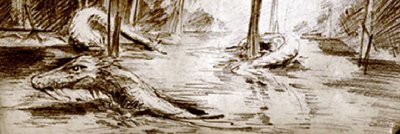
The Phaya Naga or Naga are mythical serpent-like creatures believed by locals to live in theLaotian stretch of the Mekongriver or estuaries. People in both Laos and Thailand attribute the Naga fireballs to these creatures .


undefined
undefined

Poukai

Posted in 
In Māori mythologyPouakaiPoukaiHokioi, orHakawai is a monstrous bird that ate people.
According to an account given to Sir George Grey, an early governor of New Zealand, Hokioi were huge black-and-white predators with a red crest and yellow-green tinged wingtips.
In some Māori legends, Hokioi kill humans, which could have been possible if the name relates to theHaast's Eagle, given the massive size and strength of the bird which is believed to have hunted Moaweighing up to 300 pounds (140 kg). Such a creature could have very well killed and eaten humans, and it did not become extinct until several hundred years after the arrival of the Māori.
A different theory posits that the "Hokioi" legends may refer to the New Zealand Snipe – specifically, the extinct South Island subspecies


undefined
undefined

Popobawa

Posted in 
Popobawa, also Popo Bawa, is the name of an evil spirit, orshetani,[1] which is believed by residents to have first appeared on the Tanzanian island of Pemba. In 1995 it was the focus of a major outbreak of mass hysteria or panicwhich spread from Pemba to Unguja, the main island of theZanzibar archipelago, and across to Dar es Salaam and other urban centres on the East African coast.


undefined
undefined

Pogeyan

Posted in 
The Pogeyan is a cryptid greybig cat, a feline; possibleleopard or out-of-place Asian lion, known to local people, allegedly living in the Western GhatsIndia.
The name "Pogeyan" is derived from the local dialect and means "The cat that comes and goes like the mist"

Breeds


BRIEF HISTORICAL SUMMARY : Around the turn of the century a dwarf Schnauzer from the Frankfurt/Main area went on his way, then still described as a rough haired Zwergpinscher (Miniature Pinscher). Due to the different shapes, sizes and types and the muddle of harsh, soft and silky coat textures, it was no easy task to evolve a small dog with the appearance and the characteristic qualities of his bigger brother, the Schnauzer.

GENERAL APPEARANCE : Small, strong, stocky rather than slim, rough coated, elegant. A reduced image of the Schnauzer without the drawback of a dwarfed appearance.

IMPORTANT PROPORTIONS :
Square build in which the height at the withers is nearly equal to the body length.

The length of the head (measured from the tip of the nose to the occiput) corresponds to half the length of the topline (measured from the withers to the set on of the tail).

BEHAVIOUR/TEMPERAMENT : His nature is similar to that of the Schnauzer and is determined by the temperament and the behaviour of a small dog. Intelligence, fearlessness, endurance and alertness make the Miniature Schnauzer an agreeable house dog as well as a watch and companion dog which can be kept even in a small appartment without problems.

HEAD CRANIAL REGION
Skull : Strong, long without markedly protruding occiput. The head should be in keeping with the dog’s force. The forehead is flat, without wrinkles and parallel to the bridge of nose.
Stop: Appears well defined due to the brows

FACIAL REGION
Nose : Well developed nose leather, always black.
Muzzle : Ending in a blunt wedge. Bridge of nose straight.
Lips : Black, smoot and tight-fitting to the jaws. Corners of lips closed.
Jaws/Teeth : Strong upper and lower jaw. The complete scissor bite (42 pure white teeth according to the dentition formula), is strongly developed and firmly closing. The chewing muscles are strongly developed but the cheeks must not interfere with the reactangular shape of the head (with the beard).
Eyes: Medium sized, oval, facing foreward, dark with lively expression. Eyelids close fitting.
Ears : Drop ears, set high, V-shaped with inner edges lying close to the cheeks, evenly carried , turned forward towards temples. Folds parallel, should not be above the top of the skull..

NECK : The strong, muscular neck is nobly arched, blending smoothly into the withers.
Strongly set on, slim, nobly curved, corresponding to the dog’s force. Throat skin tight-fitting without folds.

BODY
Topline : Slightly sloping from withers towards rear.
Withers: Forming the highest point in topline.
Back: Strong, short and taut.
Loins : Short, strong and deep. The distance from the last rib to the hip is short to make the dog appear compact.
Croup : Slightly rounded and imperceptibly blending into tail set on.
Chest : Moderately broad, oval in diameter, reaching to the elbows. The forechest is distinctly marked by the point of the sternum.
Underline and belly : Flanks not too tucked up, forming a well curved line with the underside of the ribcage.

TAIL : Natural; a sabre or sickle carriage is sought after.

LIMBS FOREQUARTERS : Seen from the front, the front legs are strong, straight and not close together. Seen from the side, the forearms are straight.
Shoulders: The shoulder blade lies close against the rib cage and is well muscled on both sides of the shoulder bone, protruding over the points of the thoracic vertebrae. As sloping as possible and well laid back, forming an angle of appr. 50° to the horizontal.
Upper arm: Lying close to the body, strong and well muscled, forming an angle of 95° to 105° to the shoulder blade.
Elbows: Close fitting, turning neither in nor out.
Forearm : Viewed from all sides, completely straight, strongly developed and well muscled.
Carpal joint: Strong, firm, barely standing out against the structure of the forearm.
Pastern : Seen from the front, vertical. Seen from the side slightly sloping towards the ground, strong and slightly springy.
Forefeet : Short and round. Toes well-knit and arched (cat foot) with short dark nails and resistant pads.


HINDQUARTERS : Standing obliquely when seen from the side, standing parallel but not close together when seen from the rear.
Upper thigh : Moderately long, broad and strongly muscled.
Stifle :Turning neither in nor out.
Lower thigh : Long, strong and sinewy, running into a strong hock.
Hock : Very well angulated, strong, firm, turning neither in nor out.
Metatarsus : Short, vertical to the ground.
Hind feet : Toes short, arched and well-knit. Nails short and black.

GAIT/MOVEMENT: Flexible, elegant, agile, free and ground covering. The forelegs swinging as far forward as possible, the hind legs, ground covering and springy, provide the necessary drive. The front leg of one side and the hind leg of the other side move forward at the same time. The back, the ligaments and the joints are firm.

SKIN : Tight fitting over the whole body.

COAT HAIR : The coat should be wiry, harsh and dense. It consists of a dense undercoat and a not too short top coat, lying close to the body. The top coat is rough and sufficiently long to allow the checking of its texture; it is neither bristly nor wavy. The hair on the limbs tends to be less harsh. Coat short on forehead and ears. Typical characteristics are the not too soft beard on the muzzle and the bushy eyebrows which slightly shade the eyes.

COLOUR
Pure black with black undercoat.
Pepper and Salt.
Black/Silver.
Pure white with white undercoat.

When breeding Pepper and Salt, the aim is a medium shading with evenly distributed, well pigmented, pepper colouring and grey undercoat. The shades from dark iron grey to silver grey are all permitted. In all colour variations there must be a dark mask, which should adapt harmoniously to the respective colour. Distinct light markings on head, chest and limbs are undesirable.
For the Black/Silver colour, the aim in breeding is a black top coat with black undercoat, white markings over the eyes, on the cheeks, at the beard, at the throat, in two divided triangles at the front of the chest, on the front pasterns, on the feet, on the inside of the hind legs and around the anus. The forehead, the neck and the outer sides of the ears should be black like the top coat.

SIZE AND WEIGHT
Height at withers Dogs and bitches between 30 and 35 cm.

Weight Dogs and bitches approximately 4 to 8 kg.

FAULTS : Any departure from the foregoing points should be considered a fault and the seriousness with which the fault should be regarded should be in exact proportion to its degree.
Particularly:
Heavy or round skull.
Wrinkles on forehead.
Short, pointed or narrow muzzle.
Pincer bite.
Strongly protruding cheeks or cheekbones.
Light, too large or round eyes.
Low set, too long or unevenly carried ears.
Throatiness.
Dewlap, narrow crest or neck.
Too long, tucked up or soft back.
Roach back.
Croup falling away.
Tail set inclined towards head.
Long feet.
Pacing movement.
Too short, too long, soft, wavy, shaggy, silky coat.
Brown undercoat.
A black trace on the back or a black saddle.
In Black/Silver not clearly separated triangles on the chest.
Over- or undersize up to 1 cm.

SERIOUS FAULTS :
Clumsy or light build. Too low or too high on leg.
Inverse sexual type (e.g. doggy bitch).
Elbows turning out.
Straight or open hocked hindlegs.
Lower thigh too long.
Hocks turning inwards.
Rear pastern too short.
White or spotted coat in black or pepper and salt dogs.
Patchy coat in the colours black/silver and white.
Over- or undersize by more than 1 cm but less than 2 cm.
DISQUALIFYING FAULTS :
Shy, aggressive, vicious, exaggeratedly suspicious or nervous behaviour.
Malformation of any kind.
Lack of breed type.
Faulty mouth, such as over- or undershot or wry mouth.
Severe faults in individual parts, such as faults in construction, coat and colour.
Over- or undersize by more than 2 cm.

Any dog clearly showing physical or behavioural abnormalities shall be disqualified

NB : Male animals should have two apparently normal testicles fully descended into the scrotum.